<meta name='impact-site-verification' value='34369dc5-877c-4282-90a9-36f86721ccfa'>
Unlock Your Inner Historian: 150 Expert Historical Trivia Questions & Answers

Introduction: Unleash Your Passion for the Past
History is more than a collection of dates and events; it’s the grand, unfolding story of humanity. It’s a narrative filled with triumphs, tragedies, innovations, and ideas that have shaped the world we live in today. For many, however, history can feel distant or inaccessible. A great trivia quiz bridges that gap, transforming passive learning into an active challenge. This collection of expert historical trivia questions is designed to do just that—to ignite your curiosity, test your knowledge, and connect you more deeply with the past.
Beyond Dates and Names: The True Essence of History
History isn’t just about memorizing who did what and when. It’s about understanding the why—the complex web of cause and effect that connects empires, revolutions, and the quiet moments of daily life. True historical understanding comes from seeing the patterns, appreciating the context, and recognizing how past decisions echo into our present. This trivia quiz pushes beyond simple recall, encouraging you to connect the dots across different eras and cultures.
What Makes These “Expert” Questions? Deep Dives & Nuanced Narratives
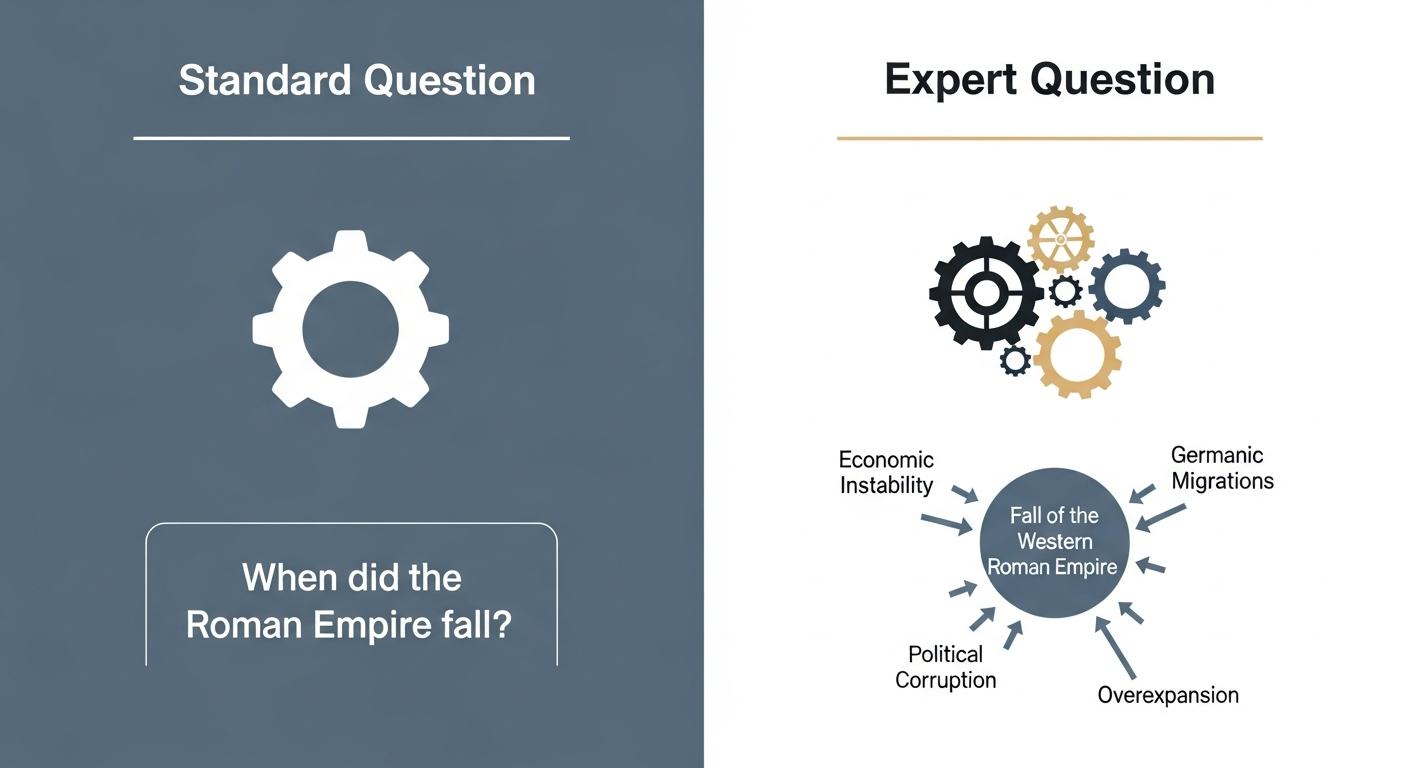
Expert questions delve into the ‘why,’ connecting the multiple factors that shape historical events, unlike standard questions that often focus on a single fact.
These are not your average history questions. An expert-level question delves into the specifics, probing the lesser-known facts, the pivotal but often overlooked figures, and the nuanced details that change our understanding of major events. They challenge you to move beyond the headlines of history textbooks and explore the intricate machinery working behind the scenes, from the economic drivers of a war to the scientific discovery that altered a generation.
Your Journey into the Ages: How This Article Will Challenge You
Prepare to journey from the cradle of civilization to the complexities of the 20th century. This article is structured to guide you through distinct eras, each filled with questions designed to be both challenging and illuminating. Whether you’re a seasoned history buff or a curious newcomer, you will find questions that surprise you, stump you, and ultimately deepen your appreciation for the rich tapestry of our shared past. Get ready to test your wits and perhaps learn something new about the world.
Why Expert Historical Trivia Matters: Cultivating a Deeper Understanding
Engaging with history on a deeper level is more than an academic exercise; it’s a crucial tool for critical thinking and informed citizenship. In an era of information overload, understanding the past provides the context needed to navigate the present. Unfortunately, engagement with the subject is often lacking. A recent AHA survey showed a 2.7 percent decline in undergraduate history enrollments, indicating a need for more compelling ways to connect with the past.
Sharpening Your Historical Lens: Connecting Events and Consequences
Expert trivia forces you to look beyond isolated facts. A single question about a trade route can illuminate the economic pressures that led to a war. A question about a specific clause in the Declaration of Independence can reveal the philosophical debates that founded a nation. This process hones your ability to analyze how one event inevitably leads to another, creating a more sophisticated and interconnected view of history.
Challenging Assumptions: Uncovering the Lesser-Known Stories
History is often told from the perspective of the victors or the powerful. Expert trivia shines a light on the margins, introducing you to forgotten inventors, pivotal social movements, and consequential decisions that don’t always make it into the mainstream narrative. This challenges preconceived notions and encourages a more inclusive and comprehensive understanding of who and what shaped our world.
The Joy of Discovery: Learning Something New Every Time
There is a unique satisfaction in uncovering a fascinating new piece of information—a “that’s interesting!” moment that sparks further curiosity. This trivia quiz is designed to provide those moments of discovery. Despite its perceived lack of professional application, a survey by the American Historical Association found that 84 percent of respondents felt history was just as valuable as fields like engineering and business, highlighting its intrinsic worth.
From Casual Interest to Informed Perspective: The Value of Learning History
A strong grasp of history equips you with the knowledge to understand contemporary issues, from geopolitical conflicts to domestic policy debates. It transforms you from a passive observer into an informed participant in the ongoing story of humanity. With data showing that just 13 percent of eighth-grade students scored at or above proficient in U.S. history, accessible and engaging tools like trivia are more important than ever.
How to Use These 150 Expert Historical Trivia Questions
This collection is a versatile tool for learning and entertainment. Here are a few ways to make the most of this trivia quiz.
Solo Challenge: A Personal Quest for Knowledge
Test yourself. Go through the list section by section, keeping score of your correct answers. Don’t just check if you were right; take a moment to reflect on the answers you didn’t know. Use them as jumping-off points for your own research, turning a simple question into a gateway for deeper learning.
Engage with Friends & Family: Sparking Historical Debates and Discussions
Trivia is a social activity. Organize a game night with friends or family. You can go head-to-head or form teams. A great trivia question often sparks conversation and friendly debate, making history a dynamic, shared experience. Turn it into a live competition to see who is the ultimate historian in your group.
Educational Tool: Supplementing Studies and Broadening Horizons
For students and educators, these questions can serve as a fantastic supplement to formal studies. Use them as a warm-up activity in a classroom, a study aid for an exam, or a fun way to explore topics beyond the standard curriculum. They can make abstract historical concepts more tangible and memorable.
Conversation Starters: Impress and Inform with Fascinating Facts
A well-timed, interesting fact can be a great icebreaker. The knowledge you gain from this trivia can enrich your conversations, providing unique insights and perspectives. Share the most surprising facts you learn with colleagues or at social gatherings to spark engaging discussions.
Ancient Civilizations & Empires: The Foundations of Humanity
Our journey begins at the dawn of civilization, exploring the empires that laid the groundwork for law, science, and culture.
From Mesopotamia to Rome: Pioneering Societies
- Q: What legal code from ancient Babylon is one of the oldest deciphered writings of significant length? A: Code of Hammurabi.
- Q: Which civilization invented the 365-day calendar, very similar to our own? A: Ancient Egyptians.
- Q: Who was the first emperor of Rome? A: Augustus (Octavian).
- Q: What Mesopotamian epic poem is considered the first great work of literature? A: The Epic of Gilgamesh.
- Q: In what series of wars did Rome defeat Carthage for control of the Mediterranean? A: The Punic Wars.
- Q: The Library of Alexandria was located in which country? A: Egypt.
- Q: What ancient Greek city-state was known for its formidable military? A: Sparta.
- Q: Who wrote “The Republic,” a foundational text of Western philosophy? A: Plato.
- Q: What structure was built to protect China from northern invaders? A: The Great Wall.
- Q: Which emperor famously divided the Roman Empire into two halves? A: Diocletian.
- Q: The ancient city of Mohenjo-daro is located in which modern-day country? A: Pakistan.
- Q: What was the primary writing material used by the ancient Egyptians? A: Papyrus.
- Q: Which philosopher was sentenced to death in Athens for “corrupting the youth”? A: Socrates.
- Q: What civilization developed the first known use of the number zero? A: The Mayans.
- Q: The city of Troy, of Trojan War fame, was located in modern-day what? A: Turkey.
Early European & Middle Eastern Powers
- Q: The Byzantine Empire was the eastern continuation of which empire? A: The Roman Empire.
- Q: Who led the Norman Conquest of England in 1066? A: William the Conqueror.
- Q: What document, signed by King John in 1215, limited the king’s power? A: The Magna Carta.
- Q: The “Reconquista” refers to the centuries-long expulsion of which group from the Iberian Peninsula? A: The Moors (Muslims).
- Q: What was the capital of the Ottoman Empire? A: Constantinople (Istanbul).
- Q: The Carolingian Renaissance was a cultural revival under which ruler? A: Charlemagne.
- Q: The “Black Death” pandemic was caused by what bacterium? A: Yersinia pestis.
- Q: The investiture controversy was a conflict between popes and whom? A: Holy Roman Emperors.
- Q: Which dynasty ruled China after the Mongol-led Yuan dynasty? A: Ming Dynasty.
- Q: The House of Wisdom, a major intellectual center, was located in what city? A: Baghdad.
- Q: The Hanseatic League was a medieval confederation of what? A: Merchant guilds.
- Q: Who was the founder of the Mongol Empire? A: Genghis Khan.
- Q: What was the main purpose of the Domesday Book? A: To survey and tax land.
- Q: The Great Schism of 1054 split which two branches of Christianity? A: Eastern Orthodoxy & Roman Catholicism.
- Q: The Battle of Tours in 732 halted the advance of which group into Europe? A: The Umayyad Caliphate.
Global Connections: Early Explorers and Trade Routes
- Q: What trade route connected the East and West from the 2nd century BCE to the 18th century? A: The Silk Road.
- Q: Which Portuguese explorer was the first European to sail to India? A: Vasco da Gama.
- Q: The Treaty of Tordesillas divided the “New World” between which two countries? A: Spain and Portugal.
- Q: Which Chinese admiral commanded treasure voyages to the Indian Ocean? A: Zheng He.
- Q: Ferdinand Magellan is credited with the first what? A: Circumnavigation of the Earth.
- Q: The “Columbian Exchange” refers to the transfer of what between hemispheres? A: Plants, animals, diseases.
- Q: What precious metal, mined extensively in the Americas, fueled the Spanish economy? A: Silver.
- Q: The search for what fabled “Northwest Passage” drove exploration in North America? A: A sea route to Asia.
- Q: What Venetian merchant’s travels to Asia were documented in a famous book? A: Marco Polo.
- Q: Which empire controlled the trans-Saharan trade in gold and salt? A: Mali Empire.
Shaping the Modern World: Revolutions, Enlightenment & New Ideologies
This era of radical change saw the birth of new ideas about government, science, and society that still resonate today.
The Age of Enlightenment and Its Impact
- Q: John Locke’s philosophy heavily influenced which founding document of the United States? A: The Declaration of Independence.
- Q: Montesquieu’s concept of the “separation of powers” proposed what three branches of government? A: Legislative, executive, judicial.
- Q: Who wrote “The Wealth of Nations,” a foundational text of modern economics? A: Adam Smith.
- Q: The motto of the French Revolution, “Liberté, égalité, fraternité,” was inspired by which movement? A: The Enlightenment.
- Q: What scientific instrument’s improvement by Galileo Galilei revolutionized astronomy? A: The telescope.
- Q: Isaac Newton’s “Principia Mathematica” laid out which three laws? A: The laws of motion.
- Q: Which Enlightenment thinker advocated for freedom of speech and religion? A: Voltaire.
- Q: What is the name of Denis Diderot’s massive compilation of knowledge? A: Encyclopédie.
- Q: Who proposed the heliocentric model of the universe? A: Nicolaus Copernicus.
- Q: What was the dominant artistic style during the Enlightenment? A: Neoclassicism.
Political and Social Upheavals
- Q: The storming of what fortress on July 14, 1789, marks the start of the French Revolution? A: The Bastille.
- Q: Who was the principal leader of the Haitian Revolution? A: Toussaint Louverture.
- Q: The Congress of Vienna in 1815 aimed to restore what in Europe after Napoleon? A: A balance of power.
- Q: What was the name of the radical faction during the French Revolution led by Robespierre? A: The Jacobins.
- Q: The “Spring of Nations” refers to a series of revolutions across Europe in what year? A: 1848.
- Q: Who was the primary leader of the Bolshevik Revolution in Russia? A: Vladimir Lenin.
- Q: The Taiping Rebellion was a massive civil war in which country? A: China.
- Q: Simón Bolívar was a key figure in the independence of which continent? A: South America.
- Q: The Meiji Restoration marked the end of what system in Japan? A: The Shogunate (feudalism).
- Q: What event triggered the start of World War I? A: Assassination of Archduke Franz Ferdinand.
- Q: The Boxer Rebellion was an anti-foreign uprising in which nation? A: China.
- Q: What treaty officially ended World War I? A: The Treaty of Versailles.
- Q: Who wrote “The Communist Manifesto” along with Karl Marx? A: Friedrich Engels.
- Q: The “Glorious Revolution” in England established what principle? A: Constitutional monarchy.
- Q: What was the period of ideological conflict between the U.S. and the Soviet Union called? A: The Cold War.
The Dawn of Industrialization: Transforming Economies and Societies
- Q: What invention by James Watt was crucial to the Industrial Revolution? A: The steam engine.
- Q: The Luddites were 19th-century English workers who protested against what? A: Mechanization/technology.
- Q: Eli Whitney’s invention of the cotton gin increased the demand for what? A: Enslaved labor.
- Q: The first successful steam locomotive was built by whom? A: George Stephenson.
- Q: What communication device was invented by Samuel Morse? A: The telegraph.
- Q: The process of urbanization describes the mass movement of people to where? A: Cities.
- Q: What industry was the first to be industrialized? A: The textile industry.
- Q: Who developed the first commercially successful steamboat? A: Robert Fulton.
- Q: The Bessemer process was a technique for mass-producing what? A: Steel.
- Q: Which country is considered the birthplace of the Industrial Revolution? A: Great Britain.
American History: From Colonial Beginnings to Global Influence
Explore the pivotal moments that defined the United States, from its revolutionary origins to its rise as a global power.
Colonial America & The Road to Independence
- Q: What was the first permanent English settlement in North America? A: Jamestown, Virginia.
- Q: The “shot heard ’round the world” was fired at which battles? A: Lexington and Concord.
- Q: Who was the primary author of the Declaration of Independence? A: Thomas Jefferson.
- Q: What 1773 protest involved colonists dumping tea into a harbor? A: The Boston Tea Party.
- Q: Thomas Paine’s influential pamphlet advocating for independence was titled what? A: “Common Sense.”
- Q: What was the final major battle of the American Revolution? A: Battle of Yorktown.
- Q: The French and Indian War was part of a larger global conflict known as what? A: The Seven Years’ War.
- Q: Which colony was founded by Quakers seeking religious freedom? A: Pennsylvania.
- Q: The Stamp Act of 1765 imposed a direct tax on what? A: Printed materials.
- Q: Who famously said, “Give me liberty, or give me death!”? A: Patrick Henry.
The Young Republic & Westward Expansion
- Q: What 1803 land deal doubled the size of the United States? A: The Louisiana Purchase.
- Q: The Lewis and Clark Expedition was tasked with exploring what territory? A: The Louisiana Purchase territory.
- Q: What policy warned European nations against colonizing the Americas? A: The Monroe Doctrine.
- Q: The Trail of Tears refers to the forced removal of which Native American nation? A: The Cherokee Nation.
- Q: The concept that the U.S. was destined to expand across the continent is known as what? A: Manifest Destiny.
- Q: The War of 1812 was fought between the U.S. and whom? A: Great Britain.
- Q: What was the primary cause of the Mexican-American War? A: The annexation of Texas.
- Q: The California Gold Rush began in what year? A: 1849.
- Q: What purchase from Russia in 1867 added a massive northern territory? A: The purchase of Alaska.
- Q: What invention spurred the growth of “cowboy culture” in the West? A: Barbed wire.
A Nation Divided: The Civil War Era
- Q: What compromise admitted Missouri as a slave state and Maine as a free state? A: The Missouri Compromise.
- Q: The Supreme Court’s Dred Scott decision ruled that African Americans were not what? A: Citizens.
- Q: What was the first state to secede from the Union? A: South Carolina.
- Q: Which battle is considered the turning point of the Civil War? A: The Battle of Gettysburg.
- Q: The Emancipation Proclamation freed slaves in which areas? A: The Confederate states.
- Q: Who was the President of the Confederate States of America? A: Jefferson Davis.
- Q: General William T. Sherman’s “March to the Sea” ended in what city? A: Savannah, Georgia.
- Q: Where did Confederate General Robert E. Lee surrender to Ulysses S. Grant? A: Appomattox Court House.
- Q: Who assassinated President Abraham Lincoln? A: John Wilkes Booth.
- Q: What was the period of rebuilding after the Civil War called? A: Reconstruction.
The 20th Century: Challenges, Growth & Social Change
- Q: In what decade did the Great Depression begin? A: The 1920s (specifically 1929).
- Q: Franklin D. Roosevelt’s program to combat the Depression was called what? A: The New Deal.
- Q: The U.S. entered World War II after the attack on what location? A: Pearl Harbor.
- Q: What landmark 1954 Supreme Court case desegregated public schools? A: Brown v. Board of Education.
- Q: The “Space Race” was a competition between the U.S. and which country? A: The Soviet Union.
- Q: Who delivered the famous “I Have a Dream” speech during the March on Washington? A: Martin Luther King Jr.
- Q: The Civil Rights Act of 1964 was signed into law by which President? A: Lyndon B. Johnson.
- Q: The Watergate scandal led to the resignation of which U.S. President? A: Richard Nixon.
- Q: What was the name for the period of intense anti-communist suspicion in the 1950s? A: McCarthyism.
- Q: In what year did the Berlin Wall fall, symbolizing the end of the Cold War? A: 1989.
Indigenous Histories of the United States
- Q: The Iroquois Confederacy was a powerful alliance of how many tribes? A: Six (originally five).
- Q: What battle, also known as Custer’s Last Stand, was a major Native American victory? A: Battle of the Little Bighorn.
- Q: Who was the Shawnee leader who attempted to form a confederation to resist U.S. expansion? A: Tecumseh.
- Q: The Wounded Knee Massacre in 1890 is considered the end of what? A: The American Indian Wars.
- Q: The “Code Talkers” used their native languages for secure communications during which war? A: World War II.
World at War: 20th Century Conflicts and Global Realignments
The 20th century was defined by two world wars that reshaped global politics, geography, and technology.
- Q: World War I was primarily fought between the Allied Powers and which alliance? A: The Central Powers.
- Q: What type of combat characterized the Western Front in World War I? A: Trench warfare.
- Q: The sinking of which passenger liner by a German U-boat outraged Americans? A: The Lusitania.
- Q: The Zimmerman Telegram proposed a military alliance between Germany and what country? A: Mexico.
- Q: What was the “Red Baron’s” real name? A: Manfred von Richthofen.
- Q: The League of Nations was a precursor to what modern international organization? A: The United Nations.
- Q: The invasion of which country by Germany triggered the start of World War II in Europe? A: Poland.
- Q: The Battle of Britain was primarily fought in what domain? A: The air.
- Q: What was the code name for the Allied invasion of Normandy on D-Day? A: Operation Overlord.
- Q: Which battle in the Pacific is considered the turning point of the war against Japan? A: The Battle of Midway.
- Q: The secret U.S. program to develop the atomic bomb was called what? A: The Manhattan Project.
- Q: What was the “Final Solution”? A: The Nazi plan for the genocide of Jews.
- Q: The Nuremberg Trials prosecuted leaders from which country for war crimes? A: Nazi Germany.
- Q: Which two Japanese cities were targeted by atomic bombs? A: Hiroshima and Nagasaki.
- Q: The “Phoney War” refers to the quiet early period of which conflict? A: World War II.
- Q: The Battle of Stalingrad was a brutal turning point on which front? A: The Eastern Front.
- Q: Who was the British Prime Minister for most of World War II? A: Winston Churchill.
- Q: The Korean War was a conflict between which two opposing ideologies? A: Communism and capitalism.
- Q: The Viet Cong primarily used what type of warfare against U.S. forces? A: Guerrilla warfare.
- Q: The Cuban Missile Crisis brought the U.S. and Soviet Union to the brink of what? A: Nuclear war.
- Q: What was the name of the U.S. foreign policy to prevent the spread of communism? A: Containment.
- Q: The “Iron Curtain” was a term popularized by whom to describe the division of Europe? A: Winston Churchill.
- Q: What does NATO stand for? A: North Atlantic Treaty Organization.
- Q: Who was the leader of the Soviet Union during the Cuban Missile Crisis? A: Nikita Khrushchev.
- Q: Which European nation colonized Brazil, influencing its language and culture? A: Portugal.
- Q: In what year did the first modern Olympic sports competition take place in Athens? A: 1896.
- Q: The first “talkie” or motion picture with sound was what film? A: “The Jazz Singer.”
- Q: Marie Curie was the first woman to win a Nobel Prize, and did so in what field of science? A: Physics.
- Q: Jackie Robinson breaking the color barrier in baseball was a milestone for sports and what movement? A: The Civil Rights movement.
- Q: The Falklands War was fought between the United