<meta name='impact-site-verification' value='34369dc5-877c-4282-90a9-36f86721ccfa'>
How Old Is the United States? Different Ways to Count America’s Age

Ask any American on the street, and they’ll confidently tell you the United States is 249 years old as of 2025. Count from July 4, 1776—when the Continental Congress adopted the Declaration of Independence—and the math is straightforward. But this seemingly simple question about America’s age reveals something fascinating about how nations are born and evolve.
The truth is, determining when the United States truly “began” depends entirely on which foundational moment you choose as your starting point. Was America born when colonists declared independence from Britain? When the Constitution created a functioning government? Or perhaps during one of the many other pivotal moments that shaped the nation’s identity?
Each potential birthday tells a different story about America’s journey from rebellious colonies to global superpower. Some dates highlight political milestones, others focus on cultural transformation, and a few even predate European arrival entirely. Understanding these various perspectives offers more than just historical trivia—it illuminates the complex, ongoing process of nation-building that continues today.
Let’s explore the different ways to measure America’s age and discover what each reveals about the country’s remarkable evolution.
The Traditional Answer: 249 Years From the Declaration of Independence
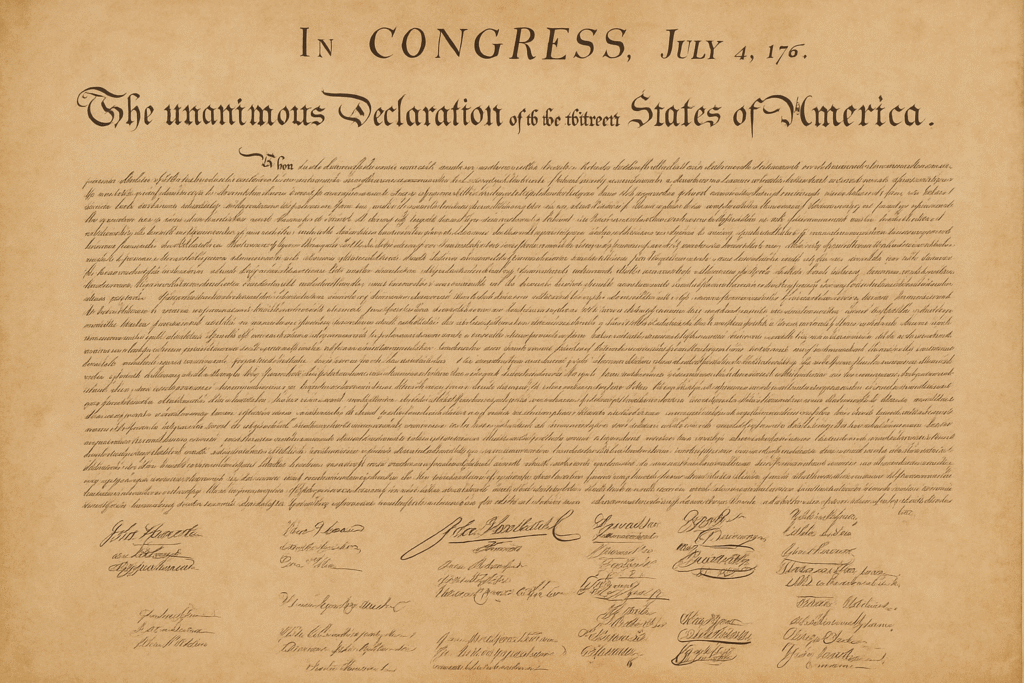
July 4, 1776 stands as America’s most widely recognized birthday. On this date, the Second Continental Congress adopted the Declaration of Independence, formally announcing the thirteen colonies’ separation from British rule. This wasn’t merely a political statement—it was a revolutionary manifesto that articulated new principles of government based on individual rights and democratic ideals.
The Declaration emerged from years of mounting tensions between Britain and its American colonies. Restrictive policies like the Stamp Act and Tea Act, combined with the principle of “taxation without representation,” had pushed colonial leaders toward rebellion. Interestingly, the phrase “United States of America” had already appeared in print by January 1776, showing that the concept of a unified American nation was taking shape even before independence was declared.
The document itself, primarily authored by Thomas Jefferson, did more than announce separation from Britain. It established philosophical foundations that would influence democratic movements worldwide. The famous assertion that “all men are created equal” and possess “unalienable rights” became cornerstones of American identity, even as the nation struggled to fully realize these ideals.
This is why Americans celebrate July 4th with fireworks, parades, and patriotic festivities. It marks the moment when separate colonies united under a shared vision of self-governance and individual liberty. As the nation approaches its 250th anniversary in 2026, this traditional birthday remains the most commonly accepted measure of America’s age.
The Constitutional Perspective: 235 Years From Ratification
While the Declaration of Independence announced America’s birth, the Constitution gave the nation its enduring structure. Ratified in 1788 and implemented in 1789, the Constitution transformed a loose confederation of states into a functioning federal republic. From this perspective, the United States is 236 years old as of 2025.
The years between 1776 and 1789 were chaotic and uncertain. The Articles of Confederation, adopted in 1781, created a weak central government that struggled to address the new nation’s challenges. States operated almost like separate countries, printing their own money and maintaining their own militaries. Economic problems and political instability threatened to tear apart the fragile union.
The Constitutional Convention of 1787 changed everything. Delegates crafted a revolutionary framework that balanced federal and state power, established checks and balances between government branches, and created mechanisms for peaceful transitions of authority. The Constitution’s seven articles established the legislative, executive, and judicial branches while defining their respective powers and limitations.
This constitutional framework proved remarkably durable. Despite being amended 27 times, the basic structure established in 1789 continues to govern the United States today. The Constitution created institutions that could adapt to changing circumstances while maintaining stability and continuity. Many scholars argue that this moment, rather than 1776, marks the true beginning of the United States as we know it.
The difference matters because it highlights the distinction between declaring independence and actually building a sustainable nation. While 1776 represents America’s ideological birth, 1789 represents its practical beginning as a functioning democracy.
Alternative Starting Points: Other Ways to Measure America’s Age
Beyond the traditional markers of 1776 and 1789, several other dates offer compelling claims as America’s true beginning. Each reflects different aspects of the nation’s complex origins and development.
Native American Arrival (15,000-40,000 years ago)
Long before European colonization, Indigenous peoples inhabited North America for thousands of years. Archaeological evidence suggests Native Americans first arrived between 13,000 and 38,000 BCE, crossing a land bridge from Siberia. From this perspective, the continuous human habitation of what would become the United States spans tens of thousands of years.
This viewpoint recognizes that America’s story didn’t begin with European arrival. Native American civilizations like the Iroquois Confederacy, Cherokee Nation, and Pueblo peoples developed sophisticated governmental systems, trade networks, and cultural traditions that influenced later American development. Their presence and contributions represent the deepest roots of American history.
European Contact (532 years ago)
Christopher Columbus’s 1492 arrival in the Americas marked the beginning of permanent contact between European and Native American civilizations. While Columbus never set foot on the continental United States, his voyages initiated the age of European exploration and colonization that would eventually create the thirteen colonies.
This date represents the start of the cultural exchange, conflict, and transformation that ultimately produced American society. However, celebrating Columbus’s arrival has become increasingly controversial due to its devastating impact on Indigenous populations through disease, warfare, and displacement.
First Successful Settlement (415 years ago)
The establishment of Jamestown, Virginia in 1607 marked the first permanent English settlement in what would become the United States. Unlike the failed Roanoke colony of 1587, Jamestown survived despite facing starvation, disease, and conflicts with local Native American tribes.
Jamestown introduced elements that would define American development: private enterprise, representative government, and cultural diversity. The Virginia House of Burgesses, established in 1619, created the first elected legislative body in the Americas. That same year, the first enslaved Africans arrived in Virginia, beginning a tragic chapter that would shape American history for centuries.
End of the Civil War (159 years ago)
Some argue that the true United States wasn’t born until the Civil War ended in 1865. This perspective suggests that the secession of Southern states dissolved the original Union, and only after their reintegration was a truly unified nation established.
The Civil War resolved fundamental questions about federal versus state authority, the nature of citizenship, and the role of slavery in American society. The post-war amendments abolished slavery, guaranteed equal protection under law, and extended voting rights. From this view, the modern United States began with Reconstruction rather than the Revolution.
What America’s Age Reveals About National Identity
The question of America’s age illuminates broader themes about national identity and historical memory. Each potential starting date emphasizes different values and priorities in how Americans understand their country’s origins and development.
Choosing 1776 celebrates ideals of liberty, self-determination, and democratic revolution. This perspective emphasizes America’s role as a beacon of freedom and its influence on democratic movements worldwide. The Declaration of Independence becomes a foundational text that continues to inspire social and political reform.
Selecting 1789 highlights institutional stability, constitutional government, and the rule of law. This view emphasizes America’s success in creating durable democratic institutions that have weathered numerous crises while adapting to changing circumstances. The Constitution becomes the central achievement that distinguishes American democracy.
Recognizing Indigenous presence acknowledges the deep roots of human civilization on the North American continent and the cultural diversity that predated European colonization. This perspective challenges narratives that begin American history with European arrival and emphasizes the ongoing presence and contributions of Native American peoples.
The debate itself reflects America’s ongoing evolution. As the nation grapples with questions about inclusion, historical justice, and national purpose, different starting dates offer different ways of understanding American identity. Rather than seeking a single correct answer, considering multiple perspectives enriches our understanding of how nations develop and change over time.
Understanding America’s Continuing Evolution
While Americans commonly cite 249 years as their nation’s age, the real story is far more complex and interesting. The United States didn’t emerge fully formed on a single date but developed through a series of transformative moments spanning centuries. Each potential birthday—whether 1776, 1789, or another significant date—captures important aspects of American development while missing others.
This complexity reflects the ongoing nature of nation-building itself. Countries aren’t born once and then remain static; they continuously evolve through political changes, social movements, territorial expansion, and cultural transformation. America’s age depends not just on when you start counting, but on which aspects of national development you consider most important.
As the United States approaches its 250th anniversary under the traditional counting method, it’s worth reflecting on all the moments that contributed to creating the nation we see today. From Indigenous civilizations through colonial settlement, revolutionary idealism through constitutional pragmatism, each chapter added essential elements to the American story.
The question of America’s age ultimately reminds us that national identity is both rooted in history and constantly evolving. Understanding these multiple perspectives helps us appreciate the complex forces that shaped the United States and continue to influence its development in the 21st century.
I think other web-site proprietors should take this web site as an model, very clean and wonderful user friendly style and design, as well as the content. You’re an expert in this topic!